Showing posts with label phishing. Show all posts

Thursday, September 2, 2021

How to Avoid Phishing Scams and Recognize Them


Scammers will use text or email messages to get your personal information. There are many things you can do in order to protect yourself against phishing attacks.

How to recognize Phishing

Scammers may use text or email messages to lure you into providing your personal information. They might try to get your account numbers, passwords, and Social Security numbers. They could have access to your bank account, email, and other accounts if they obtain this information. These phishing scammers are able to launch thousands of attacks every day, and many of them succeed. According to the Internet Crime Complaint Center of the FBI, people lost $57 Million in phishing scams within a single year.

Scammers are known to change their tactics frequently. However, there are signs that can help you identify a phishing email or text.

Phishing email and text messages can look like they are from a company that you trust. These messages may appear to be from a bank or credit card company, a social network site, an app or online store, or even a payment website.

Phishing email and text messages may tell you a story to get you to click on a link or open an attachment. They could:

  • Say they have noticed suspicious activity or attempted log-ins
  • Claim that there is a problem in your account or with your payment information
  • You must confirm certain personal information
  • Include a fake invoice
  • We want you to click on the link to make a purchase
  • If you are eligible, you can register for a government reimbursement
  • Offer a coupon to get free stuff

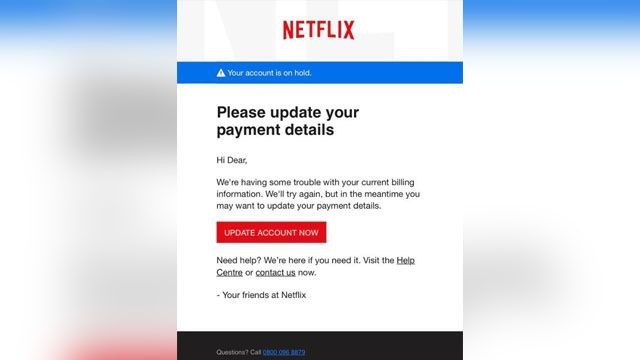
Imagine that you received this email in your inbox. Are you able to see signs it is a scam? Let’s take another look.

  • It looks like an email from Netflix. The email even has a Netflix header and logo.
  • Your email states that your account is currently on hold due to a billing issue.
  • This email uses a generic greeting: “Hi Dear.” It is unlikely that the account has an identical greeting.
  • You are invited to click on the link in the email to change your payment details.

Although it may appear real at first glance, the email is not. These email scammers are not connected to the companies they claim to represent. People who provide their details to scammers can be subject to serious consequences if they send phishing emails. They can also damage the reputation of the businesses they are spoofing.

How to Protect Yourself from Phishing Attacks

Many phishing emails may be blocked by your email spam filters. Scammers will always try to outsmart spam filters so it’s a smart idea to add additional layers of protection. These are the four steps that you can take to protect yourself against phishing attacks.

Here are four steps to protect yourself from phishing

1. Use security software to protect your computer. You can set the software to automatically update so that it can handle any new security threats.

2. Set software to automatically update your mobile phone. These updates can provide the protection you need against security threats.

3. Multi-factor authentication is a way to protect your accounts. Multi-factor authentication is a method of increasing security that requires two or more credentials to log into your account. Multi-factor authentication is what this is. You can use two types of additional credentials to log into your account:

  • You have something you have, such as a passcode that you receive via an authentication app.
  • You are what you scan — your fingerprint, retina, or face.
  • Multi-factor authentication makes it more difficult for fraudsters to log into your accounts, even if they get your username or password.

4. Backup data is important. Backup your data and ensure that they aren’t connected directly to your home network. Copy your files to an external hard disk or cloud storage. You can also back up your phone’s data.

What to do if you suspect a Phishing Attack

You may get an email, text message or phone call asking you to open an attachment or click on a link.

If you get a “No”, it may be a phishing scheme. Review the How to recognize Phishing tips and look out for signs that it is a scam. Report them and delete the message if you find them.

If you get a “Yes”, contact the company by calling the number or visiting the website. The email may not contain the correct information. Malicious malware can be installed by attaching files and linking to them.

How to Respond to a Phishing Email

IdentityTheft.gov is the place to go if you suspect that a fraudster has access to your personal information. You’ll find the steps you need to take based upon the information you have lost.

Update your security software if you suspect that you clicked on a malicious link or opened an email attachment that contained malware. Next, run a scan.

How to Report Phishing

Report any phishing emails or texts you receive. Your information can be used to fight scammers.

Step 1. If you got a phishing email, forward it to the website of the Anti-Phishing Working Group, which is reportphishing@apwg.org. You can also send phishing text messages to SPAM (7726).

Step 2. Report the attack to ReportFraud.ftc.gov.

Call SpartanTec, Inc. now and let our team of IT experts bolster your security against phishing and other forms of online attacks.

SpartanTec, Inc.
Columbia, SC 29201
(803) 408-7166
http://manageditservicescolumbia.com/

Serving: Myrtle BeachNorth Myrtle BeachColumbiaWilmingtonFayettevilleFlorence

Monday, January 18, 2021

New PayPal Phishing Attempts Are After Your Account Info


Hackers and scammers have hit the ground running in 2021, launching an extensive new phishing campaign that targets the legions of PayPal users around the world. The campaign is being run on both text message and email channels and if you're a PayPal user, you may have already seen it. If you haven't, in the days and weeks ahead, you'll probably get a text or an email to the effect that the company has detected suspicious activity on your account.

It will say the company has taken the step of "limiting" your account, which puts restrictions on withdrawing, sending or receiving money. Whether you get the text or email variant of the communication, the scammers will "helpfully" include a link, and ask you to verify your account information in order to remove these restrictions.


Naturally, this isn't a legitimate PayPal communication and if you tap or click on the link, you'll be sent to a spoof page that looks like it contains a PayPal login box. Unfortunately, if you attempt to log in, all you'll be doing is handing your login credentials over to the scammers, giving them unfettered access to your account. If you maintain a balance in your PayPal account, it will be promptly drained. If you have bank accounts or credit cards linked to your account, you can expect them to be abused.

This isn't a new idea or a new type of campaign, but it is one of the first coordinated efforts we've seen in 2021 and as such, it pays to be aware of it and improve your cybersecurity strategies.

If you get a communication regarding your PayPpal account and you even suspect that it might be true, rather than relying on the link supplied in the text or email, open a new tab and navigate to PayPal's login page manually. That's the easiest way to avoid this type of scam. You should also consider getting managed IT Services Columbia SC and let IT professionals boost your company's cybersecurity.


Call SpartanTec, Inc. now and let our team of IT experts help keep your business and client information safe from cybercriminals.


SpartanTec, Inc.
Columbia, SC 29201
(803) 408-7166
http://manageditservicescolumbia.com/

Serving: Myrtle Beach, North Myrtle Beach, Columbia, Wilmington, Fayetteville, Florence

Monday, December 21, 2020

Top 12 Christmas Cyber Scams To Watch Out For


 Christmas shoppers will be spending millions as they shop for items to buy online. Whether you’re checking a website using your company network, home connection, or public Wi-Fi connection, cyber scam will always remain as a threat. For the unsuspecting and vulnerable Christmas shoppers, this season is when cybercriminals find their prey. Don’t let these threats to your cybersecurity get in the way of the festivities.

Watch out for these 12 Christmas Cyber Scams

Email Banking Scams – the Christmas season is one of the most expensive time of the year. You may feel disconcerted if you receive an email from your bank during this festive season. Cyber criminals will exploit this and will try to pretend as a financial institution. They will send emails asking you to verify your personal information. Always keep in mind that your bank won’t get in touch with you about your personal data, so it’s better to call your bank first if you are concerned.


Phishing scams – a lot of people fall for a phishing scam. During this time of the year, firms send countless emails in a last ditch effort to promote their products or services this season. Phishing scammers send out legitimate looking emails that will infect your computer, smartphone, or other device when clicked. Be sure to open emails that were sent by a legitimate source. Don’t click on a link that does not appear legitimate and in case an email promotes an offer that’s just too good to be true then it probably is.

Public Wi-Fi Scams – are you doing some last minute Christmas shopping and stopped for a few minutes to check your email? You need to be careful if you’re using a public Wi-Fi network. Don’t share your data and files with others on the network and be sure to visit websites that have an HTTPS protocol.

Fake Free Wi-Fi – if you are trying to log into a network that asks for credit card or personal details, stop. Some Wi-Fi networks in public spaces seem to be free but in return they may ask you for your personal information. These are cybercriminals trying to steal your data.

Fake Updates – Be careful of shareable content that is infected with malware. Cybercriminals embed a malware infection on videos, images, and articles. If you send them to your contacts, their devices too will be infected.

Ransomware Viruses – This type of infection will encrypt documents and files that are stored on your device, asking for payment for their release. With phishing scams, you need to be careful win downloading or clicking content from an unknown source.

Unsecured Websites - There are websites that don’t offer a secure connection when they ask for your credit card or personal details. They may not be intentional but it’s better to be vigilant when giving out your personal information.

News Scams – cybercriminals will exploit major world news to fool unsuspecting people for their money. They make fake websites and scam emails asking for donations. The websites and emails may seem genuine but be sure to double check first before making any donations.

Fake Virus Checker – you need to install an anti-virus system. But be careful of pop up messages offering a free virus check. They won’t check for infectious files in your device but rather infect it with one.

Phone Scams – cybercriminals may also contact you through the phone. If you get a call saying they’re from your bank, make sure to ask for their credentials first. Don’t be fooled into giving out your personal information.

Internet Surfing Scams – cybercriminals can add malware to almost anything such as links, videos, images, ads, and websites. If you are surfing the internet and you come across something that does not look right then don’t click on it.

Cracked Downloads – devices like laptops are popular gifts during Christmas. Don’t be tempted to install cracked and pirated software. They are not only illegal but they may also be infected with malware.


Cybersecurity Columbia SC is a growing issue not only during Christmas but throughout the entire year. Call SpartanTec, Inc. now and let us help protect your network and devices from cybercriminals.


SpartanTec, Inc.
Myrtle Beach, SC 29577
(843) 420-9760
https://www.spartantec.com/

SpartanTec, Inc.
Columbia, SC 29201
(803) 408-7166
http://manageditservicescolumbia.com/


Serving: Myrtle BeachNorth Myrtle BeachColumbiaWilmingtonFayettevilleFlorence

Thursday, December 17, 2020

Will COVID-19 Cyberthreats Continue In 2021?


The COVID-19 pandemic has affected the world in many ways, including increased numbers of cybercrime. Criminals focused on malicious campaigns that were made to use the virus and its effects for their benefit. As COVID-19 continues to threaten the world, these kinds of attacks are expected to continue. Here are some cybersecurity threat predictions for 2021 amidst the pandemic.

Cybersecurity Threats In 2021

Phishing Campaigns

As the coronavirus continue to impact the entire world, pharmaceutical companies are in a race to create a vaccine. Phishing campaigns use the promise of a vaccine and this tactic is expected to continue until 2021.

Attacks on Remote Learners

When lockdowns were set in place, schools had no choice but to shift to e-learning. Educational facilities suffered a 30% increase in cyberattacks every weeks during the month of August as they prepare for the new semester. As the school year moves into 2021, these attacks will continue as a way to disrupt the learning activities of remote learners.


Double Extortion Ransomware Attacks

There was an increase in double extortion ransomware attacks this year. Cybercriminals captured and decrypted confidential data and then threatened to expose them publicly unless a ransom is paid. This kind of cyberthreat will persist in 2021 and the targeted and most vulnerable sector is the health industry.

Companies had to undergo digital transformations and relied mostly on the cloud to scale and run their business. However, this move also exposed a lot of vulnerable areas for cybersecurity Columbia SC attacks.

Weaponized Deepfakes

The technology that was used to make fake audio and video is now advanced that it can already be weaponized. The fake content made to trick people could be used to manipulate opinions , move the stock prices, and create other severe actions.

5G Benefits and Challenges

5G provides an environment in which essential devices are always turned on and linked at high speeds. Some examples provided by Check Point include e-health devices that could use 5G to gather medical data regarding its users, connected car services could monitor the movements of clients, as well as smart city applications may collect data regarding residents. However, without the appropriate protection, this world that’s always on could provide criminals the chance to launch cyberattacks and then disrupt the services.

One of the things that can be predicted about cybersecurity is that the threat players will always try to find ways to exploit major changes or events like COVID-19 or the introduction of the widely anticipated 5G for their own benefit. In order to stay ahead of cyberthreats, companies have to be proactive and leave no part of their business unmonitored or unprotected, or they will risk becoming another victim of the targeted and sophisticated attacks.


Call SpartanTec, Inc. now and let our team of IT experts prepare your company for potential online threats and make sure that it’s always protected.


SpartanTec, Inc.
Myrtle Beach, SC 29577
(843) 420-9760
https://www.spartantec.com/

SpartanTec, Inc.
Columbia, SC 29201
(803) 408-7166
http://manageditservicescolumbia.com/

Serving: Myrtle BeachNorth Myrtle BeachColumbiaWilmingtonFayettevilleFlorence

Tuesday, December 1, 2020

Zoom Phishing Scams: What You Need To Know


 Zoom hosted about 10 million users late last year. It was a pretty good figure for a service that only a few people knew existed. With COVID-19 burning through the entire world, preventing people from going out of their house, the user base of the service has grown to a massive 200 million users. That’s an impressive increase. However, it also comes with a threat since cybercriminals would want to have a piece of the pie.

Cybercriminals will follow the herd since that is exactly where the money is. As Zoom’s user base continue to increase, scammers will also work double time as they try to trick users by launching phishing scams.


More Hackers Impersonate Zoom

A report by Check Point Research showed that hackers have registered nearly 2,500 domains related to Zoom from April to May this year. About 320 of these domains were considered suspicious while 32 were considered malicious.

Cybercriminals are using email in order to launch phishing emails to steal the credentials of Zoom users to spread malware. Scammers will run the phishing attacks that sent legitimate looking emails. It contains a button that says open the Zoom app. But once users click on it, a malware will be downloaded on to their device.

Everyone is at risk of Zoom attacks. However, most cases involve businesses and individuals that are related to the government, transportation, manufacturing, and telecommunications.

Signs of Zoom Scams

The first email contains a Zoom account as the subject and it comes with a welcome message that’s intended for new users that recently opened an account with the service. Scammers will try to convince users to click on a malicious link to active their account by inputting their login credentials on the fake website that is controlled by the cybercriminals, who will collect and steal your information.

The second email has missed zoom meeting on the subject line. It will try to convince you that you have missed a zoom meeting and that you can check your missed conference by clicking on a link. Once you click on that, you will be directed to a fake website where you’ll be asked to enter your Zoom credentials.

The third email targets industrial firms, technology, marketing, construction, IT, energy, and manufacturing with malware, instead of phishing Columbia SC. The email subject line says your meeting has been cancelled and that you can do a Zoom call instead. Hackers are trying to get access to your personal information, computer files, and credit card details.

What to do to avoid Zoom phishing scams?

  1. Be careful when opening emails from people you don’t know. Do not reply to the email and don’t forward it to others.
  2. Do not download files or click on links on an email that comes from a person or company you don’t know.
  3. Update your operating system and all of the applications you have on your computer.
  4. Use unique and strong passwords.
  5. Zoom’s official domains are zoom.us and zoom.com. Other domains similar to these two are fake.


Call SpartanTec, Inc. now and let our IT experts help make sure that your business is safe from phishing attacks and other types of cyberthreats.


SpartanTec, Inc.
Myrtle Beach, SC 29577
(843) 420-9760
https://www.spartantec.com/

SpartanTec, Inc.
Columbia, SC 29201
(803) 408-7166
http://manageditservicescolumbia.com/

Serving: Myrtle BeachNorth Myrtle BeachColumbiaWilmingtonFayettevilleFlorence

Tuesday, October 20, 2020

Top 5 Cybersecurity Threats Faced By Small Businesses


In most cases, large companies that got hit by cyberattacks take the attention of the media. But did you know that most cyberattacks that took place last year targeted small businesses, those with less than 250 employees. Cybercrime is evolving and it has become a big and lucrative business. IT experts even predict that the cyberattacks will cost the world $6 trillion by 2021. As a small business owner, you must not take cybersecurity for granted especially if a part of most of your business are done online.


Cybercrime Statistics In 2019

  • Verizon reported that 43% of cyberattacks targeted small businesses.
  • 52% of the data breaches were done through hacking, 33% through social attacks, 28% through malware, and 15% through misuse of authorized file.
  • Jupiter research report showed that the cost of data breach in 2019 reached $2 trillion.
  • Cyberattacks increased from 40% to 55% from 2018 to 2019.
  • Symantec’s report found that 1 out of 323 mails is malicious.
  • Cybersecurity Columbia SC ventures predicted that a ransomware attack would happen every 14 seconds.


Cyberthreats For Small Businesses


Ransomware


For the past few years, ransomware has evolved into a huge threat for small, medium, and large enterprises. It is a kind of malware that encrypts the victim’s personal or work computer or other electronic device. You won’t have any access to your files for as long as the hackers want unless you pay a ransom.


Signs of Ransomware Attacks:

  • Malicious emails
  • Encrypted files
  • Locked web browser
  • Locked computer
  • Missing files from database
  • Unable to open some of your files


Phishing


Phishing is another threat to small businesses. Every business nowadays depend on emails and hackers have found a way to use it against business owners and even regular individuals.

The primary goal of phishing is to obtain confidential information. It begins with an email that aims to make the recipient believe that it comes from a legitimate sender. Once you or one of your employees opens the email, and clicks on a link, the malware will then be automatically be installed in your system or network.


Symptoms of a Phishing Attack

  • Email from an unknown individual asking for money
  • Email from a popular news organization asking you to click on “Read More” to view the whole story
  • Email from government agencies asking you to check your insurance coverage or bank deposit
  • Email about a complaint you filed


Middle Man Attacks With MITM


An MITM or man-in-the-middle attack is a smooth and clean attack that happens when a hacker targets your network and communication servers. The usual targets are ecommerce sites, SaaS businesses, and financial enterprises.


Signs of MITM Attacks

  • Popups on browser screen asking for your credentials
  • Public or open wifi network with an unusual name
  • Twin network that has a similar name with a known company’s wifi network
  • Error messages
  • Fake software updates


Drive-By Downloads Leads To Unstoppable Popups


Drive-by downloads are the main cause of unintentional downloads. This type of cyberattack happens when a malicious cod is downloaded into your mobile devices or computer system unintentionally. Your system may still be infected even if you didn’t click on any suspicious link or download now button. Hackers will always try to find a way to add a malicious code into one of the pages of a website to or directly into your HTTP.


Signs of Drive-By Downloads:

  • API calls for a different plugin
  • Your site will keep on redirecting to a different website
  • Popups keep on coming up on your screen


SQL Injection


Hackers will try to innovate or reinvent new ways to get access to databases and one of those methods is SQL injection. Structured Query Language injection takes place when a cybercriminal inserts a malicious code into your server that utilizes SQL. The problem begins once an infected server keeps the information of clients. These information may include passwords, user id, credit card numbers, and other personal information.


Call SpartanTec, Inc. now and let our team of IT experts help lessen the risk of your business from being targeted by cybercriminals.


SpartanTec, Inc.
Columbia, SC 29201
(803) 408-7166
http://manageditservicescolumbia.com/

Serving: Myrtle BeachNorth Myrtle BeachColumbiaWilmingtonFayettevilleFlorence

Monday, August 17, 2020

This New Malware Added An Email Attachment Stealer

Emotet's massive botnet was dormant for several months, but on July 17th, 2020, it suddenly rumbled back to life.
It started spewing out massive numbers of phishing emails aimed at installing Trickbot payloads on anyone unfortunate enough to open one of their poisoned emails. The emails are often described as invoices, manifests, and the like.
In recent days, security researchers have noted that Emotet has begun swapping Trickbot payloads out with QakBot payloads, which include the use of the ProLock ransomware strain. Whichever payload is deployed, however, security researchers have noticed something else. Emotet got another upgrade.
The upgrade takes the form of an email attachment stealer. Once installed on a target system, it will scan that target's inbox and sent folders looking for email attachments. The malware isn't picky, and will take anything, copying whatever files it finds and sending them to the command and control server so it can recycle and reuse the attachments on future phishing emails.


This may not sound like it, but is actually a devastatingly effective strategy. By using live files, the phishing emails gain a further air of authenticity. The data those files contain looks legitimate because it is legitimate in that the file was generated by someone working for a corporation and sent around to others for review.
Worse, Emotet doesn't show any signs of slowing down. This week, based on statistics compiled by the interactive malware analysis platform AnyRun, Emotet was ranked as the malware threat of the week. It was measured by uploads, with nearly ten times the total uploads as njRAT, which claimed the #2 spot.
Given the size of the Emotet botnet, this is definitely a threat to be mindful of. Make sure your IT staff is aware of the large scale, ongoing phishing Columbia SC campaign by the botnet and be sure to remind all of your employees not to open any email attachments unless they're absolutely certain where they're coming from.

Are you concerned with the security of your network? Phishing attacks are becoming more common and can put your company data at risk. SpartanTec Inc.provides you with peace of mind. We are your local Fortinet security provider. Contact us today for an assessment of your network.


SpartanTec, Inc.
Columbia, SC 29201
(803) 408-7166
http://manageditservicescolumbia.com/